
搜索到
7
篇与
的结果
-
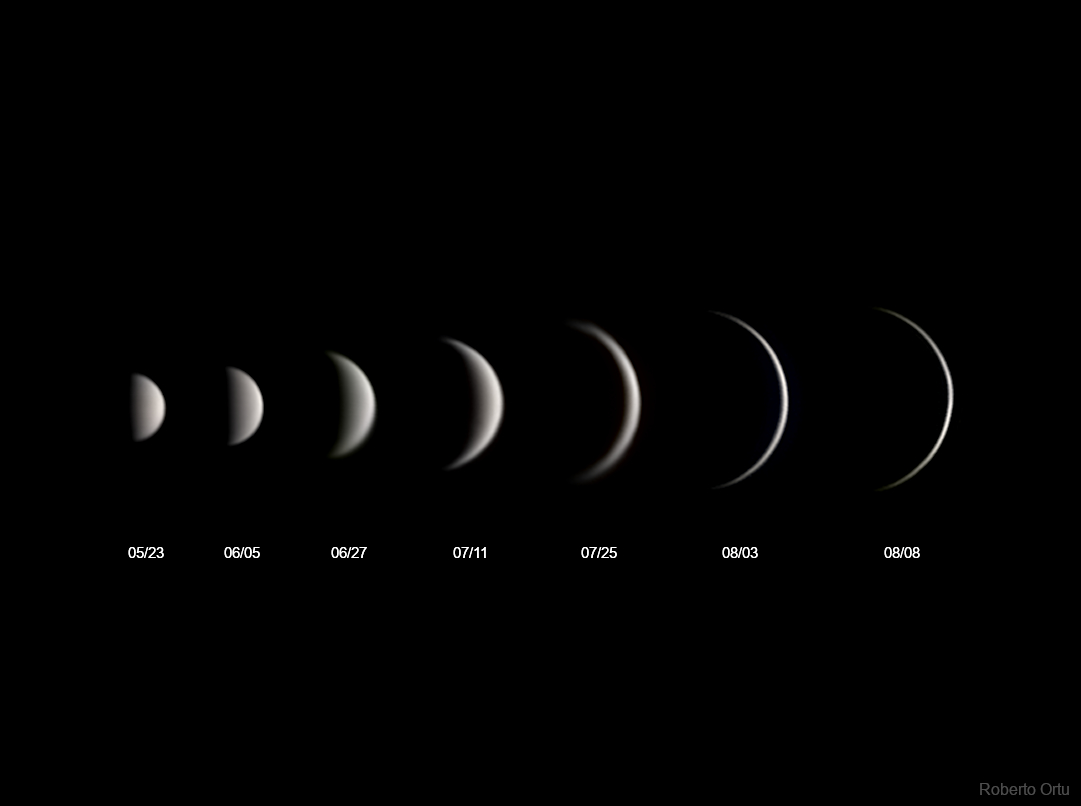
 2023年08月26日:金星的蛾眉位相-(Crescents of Venus) 2023年08月26日:金星的蛾眉位相-(Crescents of Venus)--原图下载{mtitle title="金星的蛾眉位相"/}Image Credit &Copyright: Roberto Ortu说明: 类似月亮有位相变化一样,金星可见的日耀区也会有盈亏。这组望远镜影像序列,呈现金星在2023年以昏星之姿出现的期间,日耀区渐次变化的景象。在地球与太阳之间的内行星轨道运行的金星,在这段期间的张角之所以会变大,是因为它越来越靠近地球。而它的蛾眉相之所以会愈来愈细,则是因为金星逐渐靠近我们往太阳的视线。它在8月13日来到最接近地球的下合位置,以大约8度的间距从太阳下方通过。如今金星已在清晨的东方地平线上方绽放光芒,结束了成为地球晨星的过渡。在8月21日,美国航太总署的帕克太阳探测器进行了对金星的第六次重力辅助飞越,并利用这次的相遇,操控探测器往记录上最靠近太阳的位置移动。{lamp/}原文:{mtitle title="Crescents of Venus"/}Image Credit &Copyright: Roberto OrtuExplanation: Just as the Moon goesthrough phases, Venus' visible sunlit hemispherewaxes and wanes.This sequence oftelescopicimagesillustrates the steady changes for Venus duringits recent 2023 apparition as our evening star.Gliding along its interior orbit between Earth and Sun, Venus growslarger during that period because it is approaching planet Earth.Its crescent narrows though, as the inner planet swings closer to ourline-of-sight to the Sun.Closest to the Earth-Sun line but passing about 8 degrees south of theSun, on August 13 Venus reached its (non-judgmental)inferior conjunction.And now Venus shines above the eastern horizon inpredawn skies, completing its transition to planet Earth'smorning star.On August 21, NASA's Parker Solar Probe completed its sixthgravity assist flyby of Venus, using the encounter to maneuverthe probe toward itsclosest approach yet to the Sun.
 -
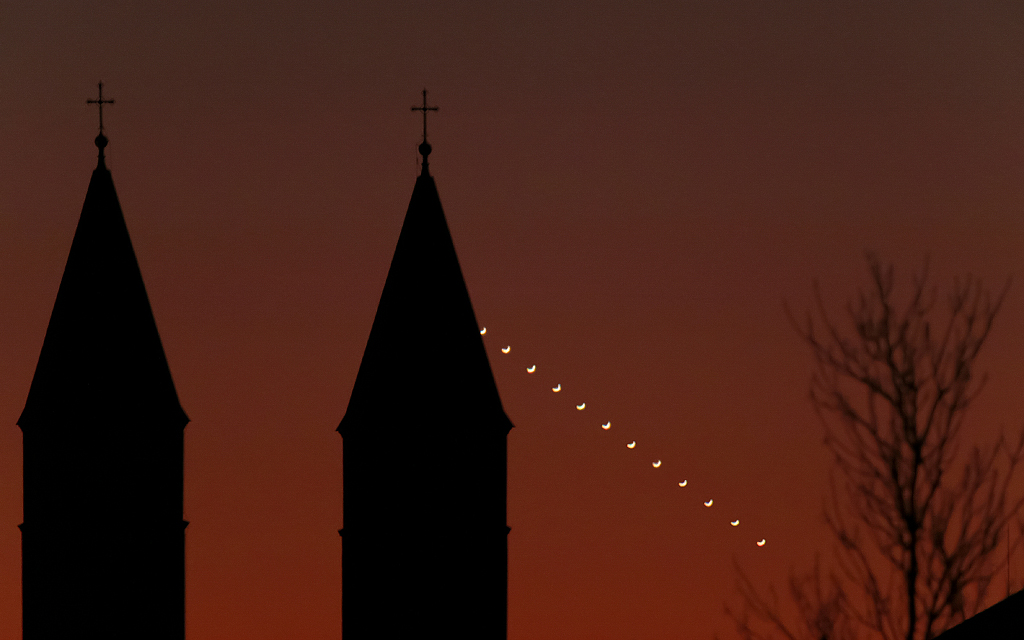
2022年01月06日:即将卸任昏星的金星-(The Last Days of Venus as the Evening Star) 2022年01月06日:即将卸任昏星的金星-(The Last Days of Venus as the Evening Star)--原图下载{mtitle title="即将卸任昏星的金星"/}Image Credit &Copyright:Tamas Ladanyi(TWAN)说明: 日落之后,悬在教堂尖塔后头的蛾眉天体,不是上弦月,而是蛾眉相的金星。在这幅用相机和长焦镜头摄于匈牙利.维斯普雷姆的序列影像里,1月1日的金星没入西天时,它与地球的间距约为4千万公里,日曜的表面则只有2%左右。在2022年刚开始的这些天里,这颗即将卸任昏星任务的明亮天体,仍在暮光中留连。不过在此同时,望远镜视窗里的金星,视张角愈来愈大,而蛾眉相则愈来愈纤细。往下合位置迈进的这颗内行星,1月9日会来到地球与太阳之间,因而淹没在太阳的炫光里。不过金星很快就会复现,在1月中旬左右,就会以晨星之姿升起,悬在日出前的东方天空中。{lamp/}原文:{mtitle title="The Last Days of Venus as the Evening Star"/}Image Credit &Copyright:Tamas Ladanyi(TWAN)Explanation: That's not a young crescent Moonposing behind cathedral towers after sunset.It's Venus in a crescent phase.About 40 million kilometers away andabout 2 percentilluminated bysunlight, it was captured with camera and telephoto lens in this seriesof exposures as it set in western skies on January 1 from Veszprem,Hungary.The bright celestial beacon was languishing in the eveningtwilight, its days as theEvening Starcoming to a close as 2022 began.But it was also growing larger in apparent size and becoming anever thinner crescentin telescopic views.Heading toward a (non-judgemental)inferiorconjunction, the inner planet will be positionedbetween Earth and Sun on January 9and generally lost from view in the solar glare.A crescent Venus will soon reappear though.Rising in the east by mid-month just before the Sun as the brilliantMorning Star.
-
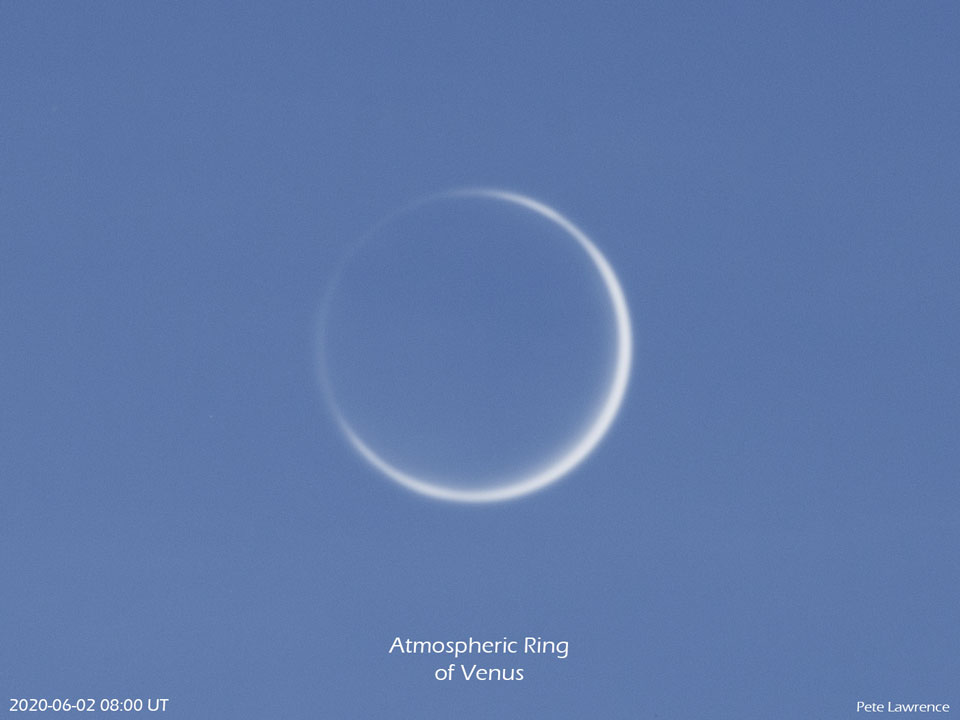
2020年06月08日:金星的大气-(Atmospheric Ring of Venus) 2020年06月08日:金星的大气-(Atmospheric Ring of Venus)--原图下载{mtitle title="金星的大气"/}Image Credit & Copyright: Pete Lawrence (Digital Sky)说明: 为什么金星旁边镶着一圈亮环?因为阳光从这个天体的周围透射过来,所以形成这种或称为火之环的景观。火之环通常在日环食期间最常出现在月盘的周围,而金星或水星 淩日时也会出现这种景观。在上星期拍摄这幅主题影像时,金星其实并未直接通过太阳前方,不过阳光还是受到金星厚重大气 折射造成了这圈环拱金星的亮环。在这次的下合事件里,从夜晚移向清晨天空的金星,于下合的位置时,它与太阳的间距小于1度。在极端明亮的太阳旁拍摄这种影像的难度极高,之所以能在英国.莱斯特郡.桑顿村取得这张影像,是因为滤镜暂时遮住了直射的阳光。影像中无所不在的蓝天辉光{lamp/}原文:{mtitle title="Atmospheric Ring of Venus"/}Image Credit & Copyright: Pete Lawrence (Digital Sky)Explanation: Why is Venus surrounded by a bright ring?Sometimes called a ring of fire, this rare ring is caused by the Sun's light being visible all around an object.Usually seen around the Moon during an annular solar eclipse, the ring of fire is also visible when either Venus or Mercury cross the face of our Sun. In the featured pictured taken last week, though, Venus did not pass directly in front of the Sun -- the complete atmospheric ring was caused by sunlight scattering around the planet.Venus passed within one degree of the Sun during its inferior conjunction, as it moved from the evening to the morning sky. The extreme brightness of the nearby Sun made capturing such an image very difficult -- the featured image was only made possible by using a temporary filter to block direct sunlight.The image was captured from Thorton, Leicestershire, UK.The pervasive blue sky glow indicates that the image was actually captured during the day.
-
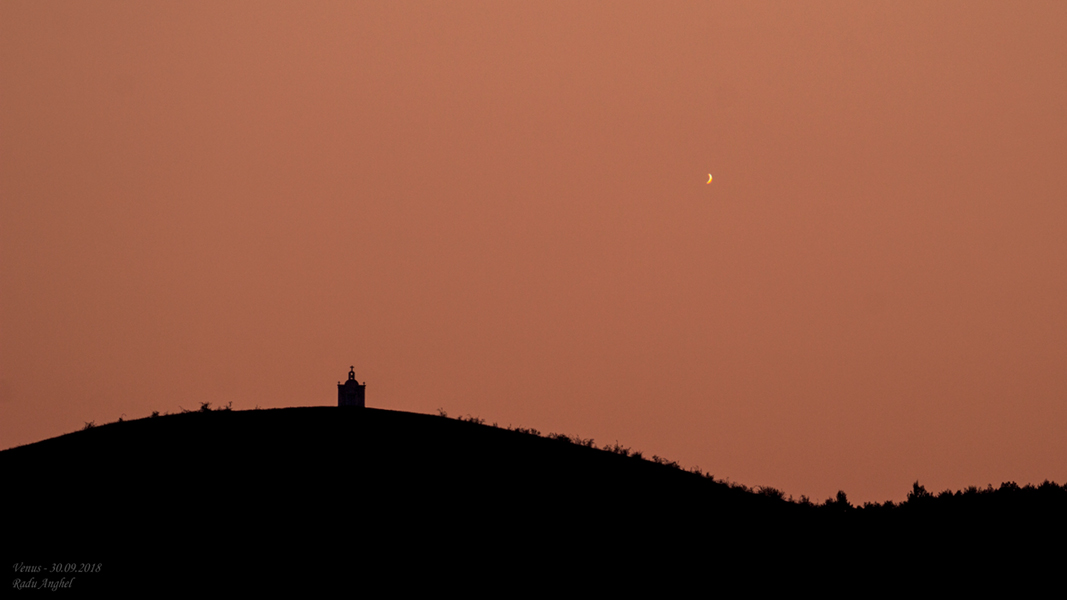
2018年10月05日:即将御任昏星的金星-(The Last Days of Venus as the Evening Star) 2018年10月05日:即将御任昏星的金星-(The Last Days of Venus as the Evening Star)--原图下载{mtitle title="即将御任昏星的金星"/}Image Credit &Copyright: Radu-Mihai Anghel说明: 日落后,悬在西方地平线山丘上空的蛾眉状天体,不是月亮,而是蛾眉相的金星。9月30日在罗马尼亚.巴寇附近拍摄这张望远镜影像时,金星大约5千4百万公里远,可见的日曜表面则少于20%。这个明亮的天体,目前在暮光中留连,然而它作为2018年昏星的日子也即将结束。不过在此同时,望远镜视窗里的金星,视张角会越来越大,但蛾眉相也越来越纤细。往下合位置迈进的这颗蛾眉状内行星,10月26日座落在地球与太阳之间,因而淹没在太阳的炫光里。在这个月底时,一轮蛾眉状的金星会出现在东方,在日出前以晨星之姿升起。{lamp/}原文:{mtitle title="The Last Days of Venus as the Evening Star"/}Image Credit &Copyright: Radu-Mihai AnghelExplanation: That's not a young crescent Moonpoised above the hills along the western horizon at sunset.It's Venus in a crescent phase.About 54 million kilometers away and less than 20 percent illuminated,it was captured by telescope and camera on September 30 near Bacau, Romania.The bright celestial beacon is now languishing in the eveningtwilight, its days as the Evening Star in 2018 coming to a close.But it also grows larger in apparent size and becomes anever thinner crescent intelescopic views.Heading toward aninferiorconjunction (non-judgmental), the inner planet will bepositioned between Earth and Sun on October 26 and lost from viewin the solar glare.At month's end a crescent Venus will reappear in the east though,rising just before the Sun as the brilliantMorning Star.
-
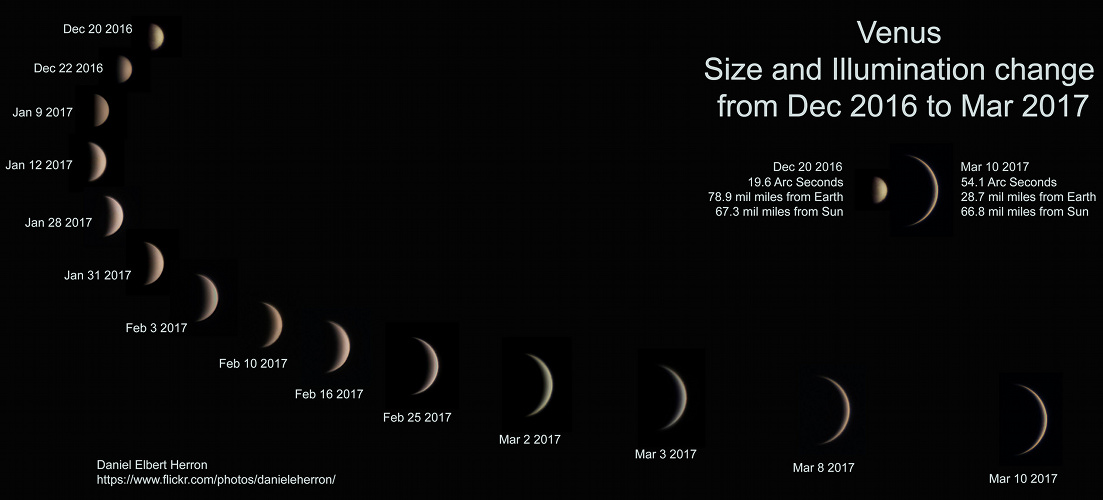
2017年03月17日:金星的位相-(Phases of Venus) 2017年03月17日:金星的位相-(Phases of Venus)--原图下载{mtitle title="金星的位相"/}Image Credit &Copyright: Daniel Herron说明: 就像月亮的月相会有变化,金星可见的日耀半球,也会有渐盈和渐亏的变化。这幅望远镜组合影像,呈现这颗内行星在西方天空以昏星之姿,于2016年12月20日到2017年3月20日之间,逐渐变大同时日耀面变窄的景象。在地球与太阳之间的内轨道绕行的金星,在这段期间之所以会变大,是因为它越来越靠近地球。而它的蛾眉相会变窄,则是因为金星越来越靠近地球往太阳的视线方向。在3月25日,金星会最接近地球─太阳的连线,并以8度左右的间距掠过太阳北方带来一次下合。紧接着,金星将会出现在清晨的东方天空,以晨星之姿绽放光芒。 明日的图片: ghostly lights{lamp/}原文:{mtitle title="Phases of Venus"/}Image Credit &Copyright: Daniel HerronExplanation: Just asthe Moon goesthrough phases,Venus' visible sunlit hemisphere waxesand wanes.Thiscomposite of telescopic images illustrates the steady changesfor the inner planet, seen in the west as the evening star,as Venus grows larger but narrows to a thin crescent fromDecember 20, 2016 through March 10.Gliding along its interior orbit between Earth and Sun, Venus growslarger during that period because it is approaching planet Earth.Its crescent narrows, though, as Venus swings closer to our line-of-sightto the Sun.Closest to the Earth-Sun line but passing about 8 degrees north of the Sunon March 25, Venus will reach a (non-judgmental)inferiorconjunction.Soon after, Venus will shine clearly above the eastern horizon inpredawn skies as planet Earth'smorning star.
-
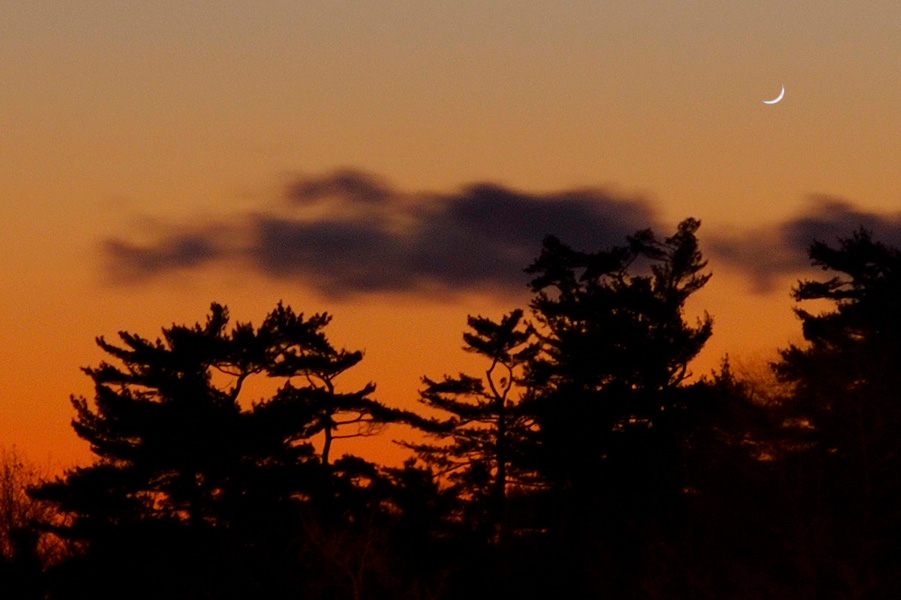
2014年01月01日:新年的新月状天体-(A New Year's Crescent) 2014年01月01日:新年的新月状天体-(A New Year's Crescent)--原图下载{mtitle title="新年的新月状天体"/}Image Credit &Copyright: Jay Ouellet说明: 日落时分,但悬在西方地平面上空的天体并非新月。这张使用望远长镜头,在地球.加拿大.魁北克市冰冷的12月30日傍晚所拍摄的天体,其实是带着眉相的金星。这颗非常明亮的天体,随着它逐渐往1月11日、位在地球与太阳之间的下合位置移动,将持续在暮光天空中沉降,同时,它的视张角也愈来愈大,而在双筒望远镜中,它的眉相也会变得更加纤细。在接下来数天的傍晚,将见到新月和眉状金星同在暮光中争辉。在1610年,伽利略是首位用自製望远镜观测金星位相变化的科学家,而其观测所见和哥白尼的日心学说吻合,但与托勒密的地心学说相违。{lamp/}原文:{mtitle title="A New Year's Crescent"/}Image Credit &Copyright: Jay OuelletExplanation: That's not the young crescent Moonpoised above the western horizon at sunset.Instead it's Venus ina crescent phase, captured with along telephoto lens from Quebec City, Canada,planet Earth on a chilly December 30th evening.The very bright celestial beacon is dropping lower into theevening twilight every day.But it also grows larger in apparent size and becomes asteadilythinner crescent in binocular views as it heads toward aninferior conjunction, positioned betweenthe Earth and the Sun on January 11.The nextfew evenings will see a young crescent Moonjoin the crescent Venus in the western twilight, though.Historically,the first observations of the phases of Venus were madeby Galileowith his telescope in 1610, evidence consistent withthe Copernican model of the Solar System, but not thePtolemaic system.