
搜索到
8
篇与
的结果
-
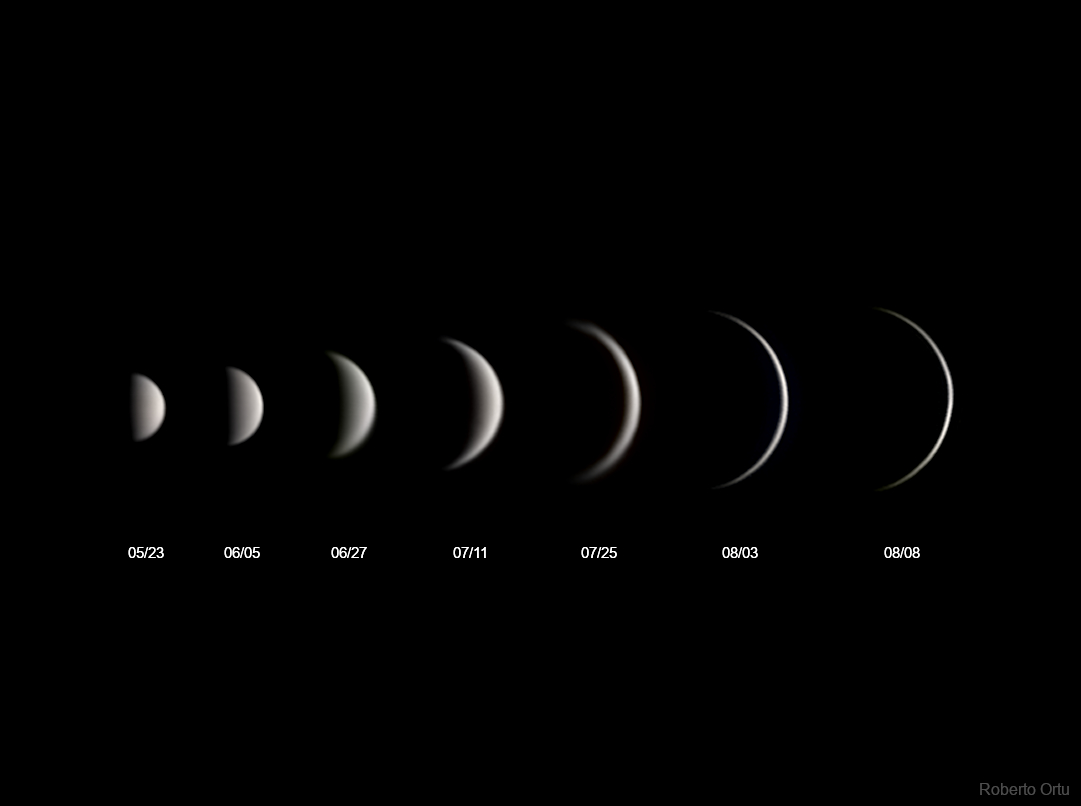
 2023年08月26日:金星的蛾眉位相-(Crescents of Venus) 2023年08月26日:金星的蛾眉位相-(Crescents of Venus)--原图下载{mtitle title="金星的蛾眉位相"/}Image Credit &Copyright: Roberto Ortu说明: 类似月亮有位相变化一样,金星可见的日耀区也会有盈亏。这组望远镜影像序列,呈现金星在2023年以昏星之姿出现的期间,日耀区渐次变化的景象。在地球与太阳之间的内行星轨道运行的金星,在这段期间的张角之所以会变大,是因为它越来越靠近地球。而它的蛾眉相之所以会愈来愈细,则是因为金星逐渐靠近我们往太阳的视线。它在8月13日来到最接近地球的下合位置,以大约8度的间距从太阳下方通过。如今金星已在清晨的东方地平线上方绽放光芒,结束了成为地球晨星的过渡。在8月21日,美国航太总署的帕克太阳探测器进行了对金星的第六次重力辅助飞越,并利用这次的相遇,操控探测器往记录上最靠近太阳的位置移动。{lamp/}原文:{mtitle title="Crescents of Venus"/}Image Credit &Copyright: Roberto OrtuExplanation: Just as the Moon goesthrough phases, Venus' visible sunlit hemispherewaxes and wanes.This sequence oftelescopicimagesillustrates the steady changes for Venus duringits recent 2023 apparition as our evening star.Gliding along its interior orbit between Earth and Sun, Venus growslarger during that period because it is approaching planet Earth.Its crescent narrows though, as the inner planet swings closer to ourline-of-sight to the Sun.Closest to the Earth-Sun line but passing about 8 degrees south of theSun, on August 13 Venus reached its (non-judgmental)inferior conjunction.And now Venus shines above the eastern horizon inpredawn skies, completing its transition to planet Earth'smorning star.On August 21, NASA's Parker Solar Probe completed its sixthgravity assist flyby of Venus, using the encounter to maneuverthe probe toward itsclosest approach yet to the Sun.
 -
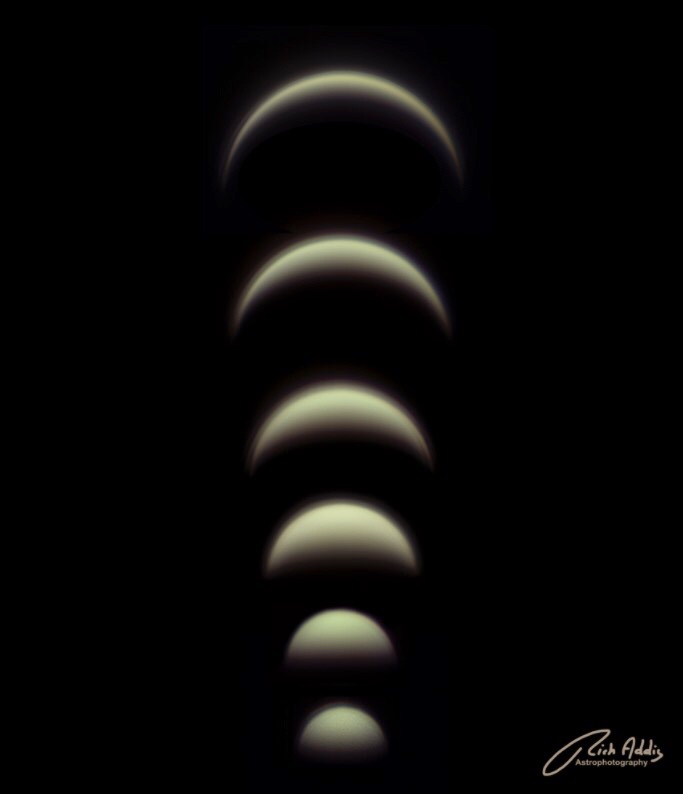
2020年05月21日:金星的位相-(Phases of Venus) 2020年05月21日:金星的位相-(Phases of Venus)--原图下载{mtitle title="金星的位相"/}Image Credit &Copyright:Richard Addis说明: 就像月亮的位相会有变化一样,金星可见的日耀区也会有盈亏。这幅后院望远镜组合影像,呈现金星在目前以昏星之姿出现的期间,日耀区变宽但面积缩成蛾眉的景象。这幅影像中的金星从下到上,分别摄于2020年2月27日、3月20日、4月14日、4月24日、5月8日和5月14日。在地球与太阳之间的内轨道绕行的金星,在这段期间之所以会变大,是因为它越来越靠近地球。而它会窄如蛾眉,则是因为金星越来越接近地球与太阳的连线。将在6月3日最接近地球-太阳连线,但从比太阳高半度的位置切过的金星,它在此时的位置称为下合。接着不久之后,金星将出现在清晨的天空中,成为地球的晨星。在今晚的日落后,西方地平线上空可见到金星,同时也能找到行蹤隐密的水星。{lamp/}原文:{mtitle title="Phases of Venus"/}Image Credit &Copyright:Richard AddisExplanation: Just asthe Moon goesthrough phases,Venus' visible sunlit hemisphere waxes and wanes.This composite of backyardtelescopic images illustrates the steady changes forVenus duringits current stint as our evening star, as the inner planet growslarger but narrows to a thin crescent.Images from bottom to top were taken during 2020 on datesFebruary 27, March 20, April 14, April 24, May 8, and May 14.Gliding along its interior orbit between Earth and Sun, Venus growslarger during that period because it is approaching planet Earth.Its crescent narrows, though, as Venus swings closer to ourline-of-sight to the Sun.Closest to the Earth-Sun line but passing about 1/2 degree north of theSun on June 3, Venus will reach a (non-judgmental)inferiorconjunction.Soon after, Venus will shine clearly above the eastern horizon inpredawn skies as planet Earth'smorning star.After sunset tonight look for Venus above the western horizonand you can also spotelusive innermost planet Mercury.
-
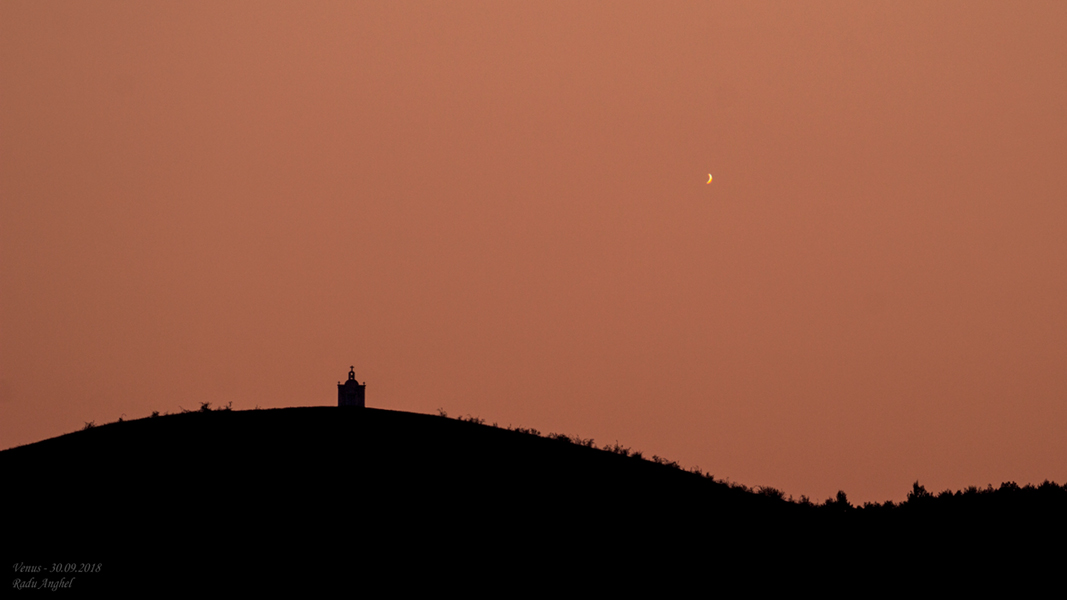
2018年10月05日:即将御任昏星的金星-(The Last Days of Venus as the Evening Star) 2018年10月05日:即将御任昏星的金星-(The Last Days of Venus as the Evening Star)--原图下载{mtitle title="即将御任昏星的金星"/}Image Credit &Copyright: Radu-Mihai Anghel说明: 日落后,悬在西方地平线山丘上空的蛾眉状天体,不是月亮,而是蛾眉相的金星。9月30日在罗马尼亚.巴寇附近拍摄这张望远镜影像时,金星大约5千4百万公里远,可见的日曜表面则少于20%。这个明亮的天体,目前在暮光中留连,然而它作为2018年昏星的日子也即将结束。不过在此同时,望远镜视窗里的金星,视张角会越来越大,但蛾眉相也越来越纤细。往下合位置迈进的这颗蛾眉状内行星,10月26日座落在地球与太阳之间,因而淹没在太阳的炫光里。在这个月底时,一轮蛾眉状的金星会出现在东方,在日出前以晨星之姿升起。{lamp/}原文:{mtitle title="The Last Days of Venus as the Evening Star"/}Image Credit &Copyright: Radu-Mihai AnghelExplanation: That's not a young crescent Moonpoised above the hills along the western horizon at sunset.It's Venus in a crescent phase.About 54 million kilometers away and less than 20 percent illuminated,it was captured by telescope and camera on September 30 near Bacau, Romania.The bright celestial beacon is now languishing in the eveningtwilight, its days as the Evening Star in 2018 coming to a close.But it also grows larger in apparent size and becomes anever thinner crescent intelescopic views.Heading toward aninferiorconjunction (non-judgmental), the inner planet will bepositioned between Earth and Sun on October 26 and lost from viewin the solar glare.At month's end a crescent Venus will reappear in the east though,rising just before the Sun as the brilliantMorning Star.
-
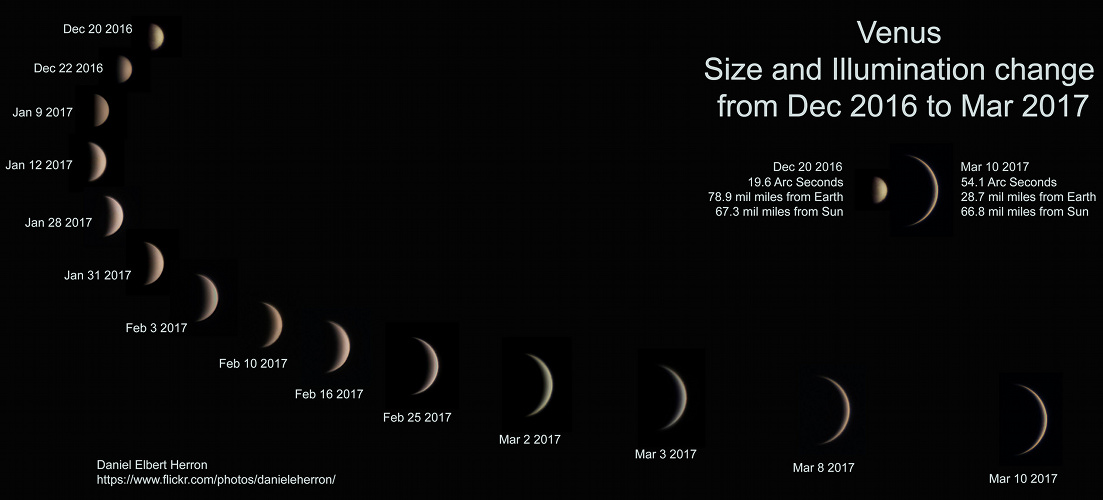
2017年03月17日:金星的位相-(Phases of Venus) 2017年03月17日:金星的位相-(Phases of Venus)--原图下载{mtitle title="金星的位相"/}Image Credit &Copyright: Daniel Herron说明: 就像月亮的月相会有变化,金星可见的日耀半球,也会有渐盈和渐亏的变化。这幅望远镜组合影像,呈现这颗内行星在西方天空以昏星之姿,于2016年12月20日到2017年3月20日之间,逐渐变大同时日耀面变窄的景象。在地球与太阳之间的内轨道绕行的金星,在这段期间之所以会变大,是因为它越来越靠近地球。而它的蛾眉相会变窄,则是因为金星越来越靠近地球往太阳的视线方向。在3月25日,金星会最接近地球─太阳的连线,并以8度左右的间距掠过太阳北方带来一次下合。紧接着,金星将会出现在清晨的东方天空,以晨星之姿绽放光芒。 明日的图片: ghostly lights{lamp/}原文:{mtitle title="Phases of Venus"/}Image Credit &Copyright: Daniel HerronExplanation: Just asthe Moon goesthrough phases,Venus' visible sunlit hemisphere waxesand wanes.Thiscomposite of telescopic images illustrates the steady changesfor the inner planet, seen in the west as the evening star,as Venus grows larger but narrows to a thin crescent fromDecember 20, 2016 through March 10.Gliding along its interior orbit between Earth and Sun, Venus growslarger during that period because it is approaching planet Earth.Its crescent narrows, though, as Venus swings closer to our line-of-sightto the Sun.Closest to the Earth-Sun line but passing about 8 degrees north of the Sunon March 25, Venus will reach a (non-judgmental)inferiorconjunction.Soon after, Venus will shine clearly above the eastern horizon inpredawn skies as planet Earth'smorning star.
-
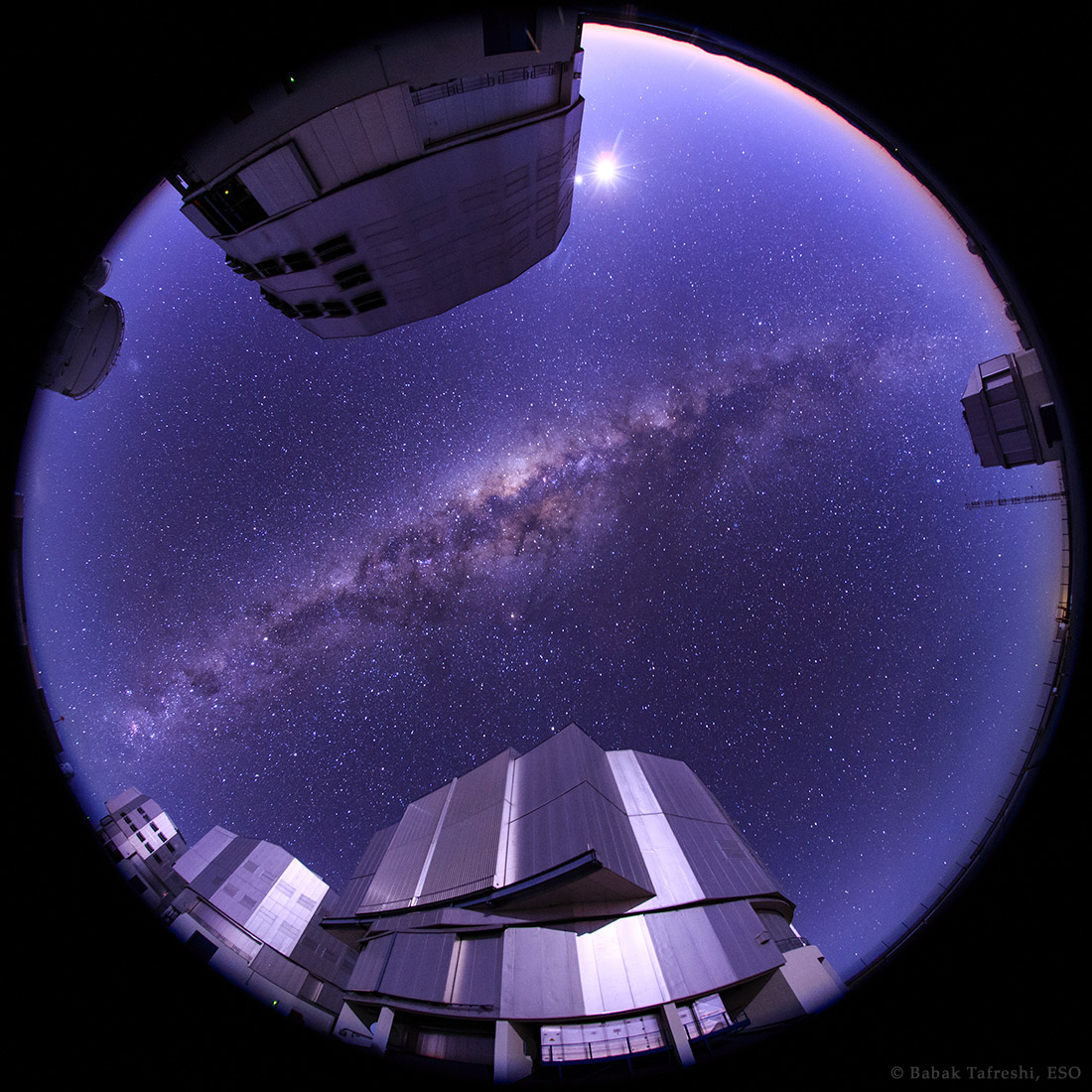
2014年03月29日:曙光中的银河-(A Milky Way Dawn) 2014年03月29日:曙光中的银河-(A Milky Way Dawn)--原图下载{mtitle title="曙光中的银河"/}Image Credit &Copyright:Babak Tafreshi(TWAN),ESO Ultra HD Expedition说明: 在3月27日的破晓时分,银河系中心悬在欧南天文台.Paranal观测站的正上方。在这幅鱼眼镜头影像中,智利阿塔卡马沙漠乾燥清朗天空中的银河系盘面,就像是被四座8米口径的极大望远镜环拱着。影像顶端所见的金星,位在东方地平面附近。而这颗明亮的晨星,几乎是贴在其中一部望远镜上,伴着邻近的残月绽放光芒。虽然东方天空拥有这对明亮的天体,但银河仍是这幅影像最吸睛的主角。由尘埃带、众星和辉光星云交织而成的银河盘面,蜿蜒横过黝黑的天顶,在此同时,深蓝的天空逐渐变亮,而建物依然在月光中闪烁。{lamp/}原文:{mtitle title="A Milky Way Dawn"/}Image Credit &Copyright:Babak Tafreshi(TWAN),ESO Ultra HD ExpeditionExplanation: As dawn brokeon March 27, the center of the Milky Way Galaxystood almost directly above the European SouthernObservatory's Paranal Observatory.In the dry, clear sky of Chile'sAtacama desert, our galaxy's dusty central bulge isflanked by Paranal's four 8 meter Very Large Telescopeunits in this astronomical fisheye view.Along the top, Venus is close to the eastern horizon.The brilliantmorning star shines very neara waning crescent Moonjust at the edge of one of the telescope structures.Despite the bright pairing in the east, the Milky Waydominates the scene though.Cut by dust lanesand charged with clouds of stars and glowing nebulae,the center of our galaxy sprawls across the darker zenitheven as the deep blue sky grows brighter and buildingsstill glint in moonlight.
-
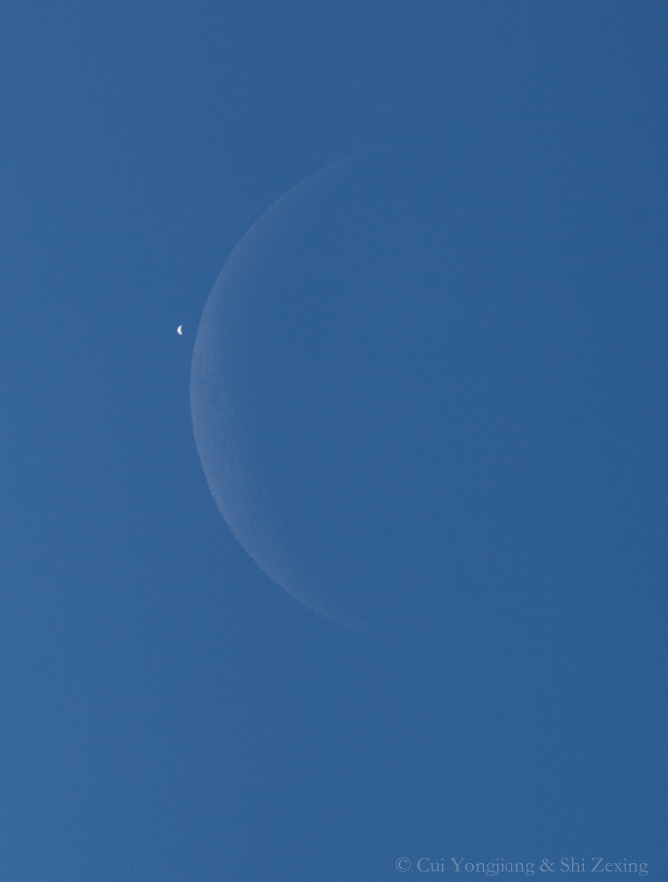
2014年02月27日:月亮与金星在大白天的聚会-(Daytime Moon Meets Morning Star) 2014年02月27日:月亮与金星在大白天的聚会-(Daytime Moon Meets Morning Star)--原图下载{mtitle title="月亮与金星在大白天的聚会"/}Image Credit &Copyright: Cui Yongjiangand Shi Zexing说明: 金星现在以地球明亮晨星之姿,出现在日出前的东方地平面上方。而在2月26日,这盏银白色泽的天体明灯和残月发生了近合。如果日出前从非洲西部某些地方看出去,弯弯的眉月实际上通过(掩过)同样是眉相的金星之前方。但在更东方的区域,月掩金星则发生在白天。这幅摄于中国云南省的成对眉状天体之望远镜近合影像,呈现了白画晴朗天空中,月掩金星发生前的景象。这个一见难忘的景观,在大白天用肉眼即可见。{lamp/}原文:{mtitle title="Daytime Moon Meets Morning Star"/}Image Credit &Copyright: Cui Yongjiangand Shi ZexingExplanation: Venus now appears as planet Earth's brilliantmorning starstanding above the eastern horizon before dawn.For most, the silvery celestialbeacon rose in a close pairingwith an old crescent Moon on February 26.But seen from locationsin western Africa before sunrise,the lunar crescent actually occulted or passed in front of Venus,also in a crescent phase.Farther to the east, the occultation occurred during daylighthours.In fact, this telescopic snapshot of thedueling crescents was capturedjust before the occultation began under an afternoon'scrystal clear skies fromYunnan Province, China.The unforgettable scene was easily visible to the naked eyein broad daylight.